

What happens to an end-of-life motorcycle helmet? In most cases, it becomes complex waste that is difficult to process because of the variety of materials it contains and the multilayer structure designed to deliver protection and durability. The question of how to dispose of an end-of-life motorcycle helmet is is far from simple.
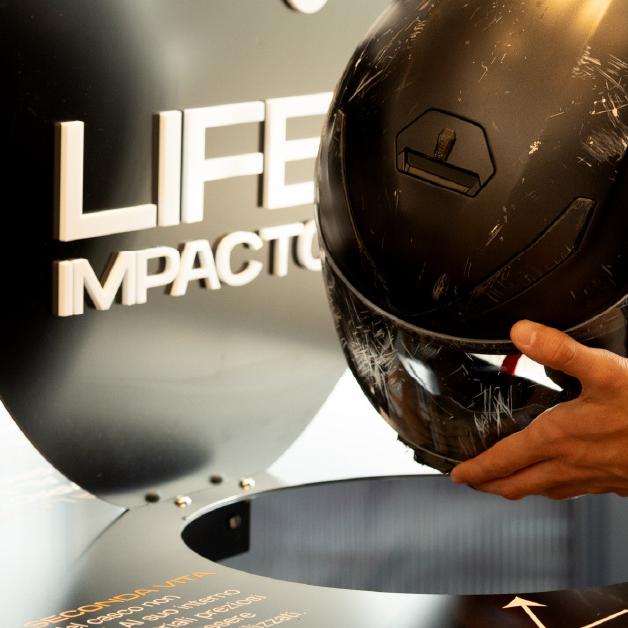
This is where Life Impacto comes in, supported by the European Union’s LIFE program, the EU funding instrument dedicated to environmental protection projects. This is not an isolated initiative, but part of a broader strategy to rethink how complex end-of-life products are managed, turning a technical challenge into an industrial opportunity.
The project is active in Dainese stores and was developed in collaboration with the University of Bologna, through the DICAM Sport Technology Lab, with Re-Sport Srl, which studies innovative solutions for recovering sports materials, with Innovando for reverse logistics management, and with Misitano & Stracuzzi for the supply of limonene.
From in-store collection to recovery
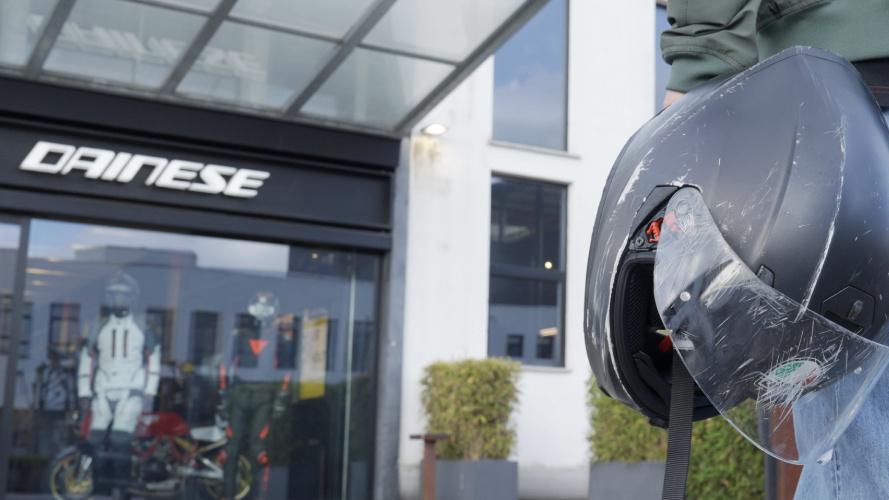
From the rider’s perspective, the process is simple: anyone can bring a used helmet to a Dainese store, regardless of brand, as long as it is a thermoplastic-shell model and not a fiber-shell one. Once collected, most of the helmets will undergo a process aimed at separating and recovering the different plastic components, reducing the amount of waste and offering a practical solution for those who do not know where to throw away a used motorcycle helmet that can no longer be used. Around 10% of the helmets will instead be analyzed by the Dainese Research and Development department, with the goal of creating increasingly safer helmets.
The first phase of the recycling process is carried out manually and involves removing the interior padding and the visor, components that follow different recovery paths.The helmet is then fed into a granulator, a machine equipped with blades that reduces it to small fragments similar to plastic confetti. This step takes only seconds and makes the material easier to process in the following stages.



Separating materials: the key challenge in motorcycle helmet recycling
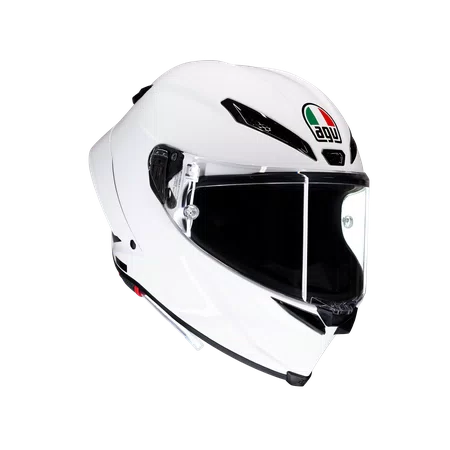
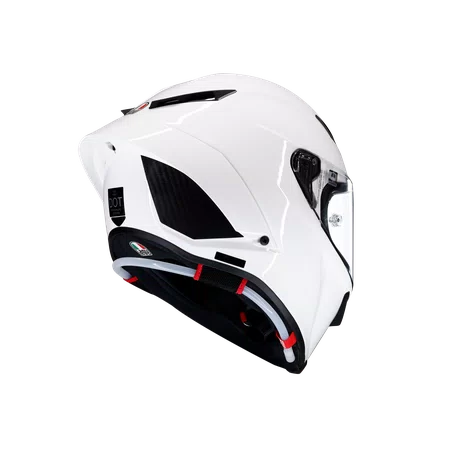
The main challenge in recycling motorcycle helmets is that multiple materials are combined in the same product: the expanded polystyrene that absorbs impacts; the high-resistance thermoplastic resins and polycarbonate plastics that make up the shell; and other polymers. To separate them, a controlled process using selective solvents is employed.
The fragments produced by grinding are immersed in a tank containing limonene, a natural solvent derived from citrus peels and a byproduct of the food industry, especially orange juice production. At this stage, the expanded polystyrene dissolves, while the other materials remain solid and are removed using a basket. The solvent is then evaporated and recovered for reuse, leaving the separated polymer behind.
The remaining material moves to a second tank containing ethyl acetate, also a natural solvent, where the high-resistance thermoplastic resin dissolves. After filtration — which removes nonrecyclable parts such as metals or mixed fabrics — the solvent is again evaporated and recovered. The recovered plastic is then left to dry and turned back into pellets, small granules ready to be used again in new manufacturing processes.
Recovering the visor and secondary components
At the same time, the visor follows a dedicated process: it is ground separately, and the recovered material, polycarbonate, is used to make other plastic parts, such as spoilers or accessory components. Direct reuse for the production of new visors is not planned, due to the especially strict optical and safety requirements this component must meet.
Processing times vary depending on the stage: from grinding, which takes just seconds, to the dissolution stages and the subsequent solvent evaporation, which can take from several dozens of minutes to several hours. A central part of the process is solvent recovery, with the solvents put back into circulation to reduce the overall environmental impact of the treatment.
A second chance for an end-of-life motorcycle helmet
Life Impacto has a twofold goal. On one hand, to reduce the number of helmets sent to landfill or incineration; on the other, to develop medium-term solutions that make it possible to integrate recycled material into the production of new helmets while maintaining the same safety standards. This is a significant technical challenge, bringing together university research and industry to define replicable and sustainable processes.
In this context, riders play a key role. Bringing your end-of-life motorcycle helmet to a sales outlet means sending it into a structured recovery process, turning a forgotten garage item into a potential resource and offering a real answer to anyone wondering how to recycle a motorcycle helmet responsibly.
How long does a motorcycle helmet last?
There is no one-size-fits-all answer. A motorcycle helmet’s lifespan depends on several factors: how often it is used, in what conditions (high temperatures, cold, rain, etc.), and how much care it receives. That is why asking how long a motorcycle helmet lasts is more accurate than talking about a true expiration date: a helmet does not expire at a specific moment like food does, but some components, such as parts subject to movement and stress like the padding and chin strap, wear out with use.
In general, replacing a helmet within five years of purchase is recommended. It should still be replaced sooner if there are clear signs of wear or deterioration in critical elements such as the shell, chin strap, EPS, and mechanisms or, more importantly, after an impact.