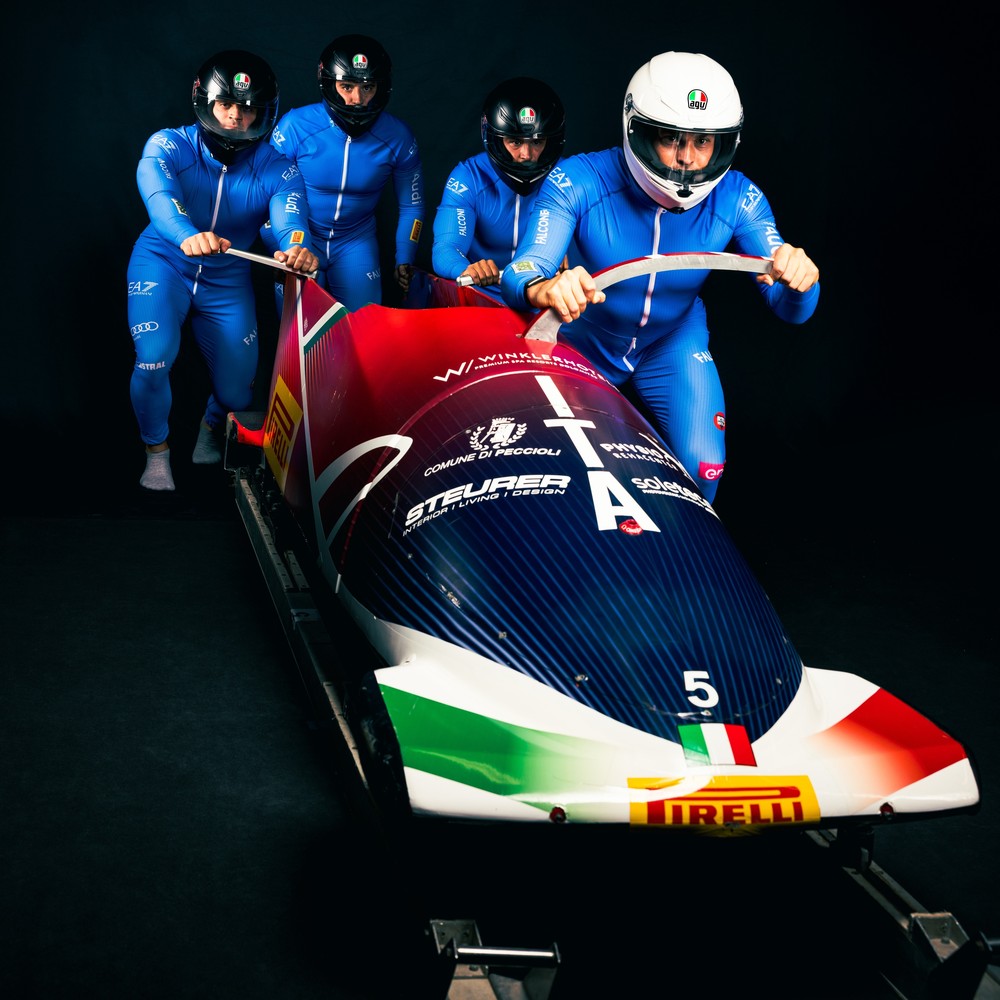


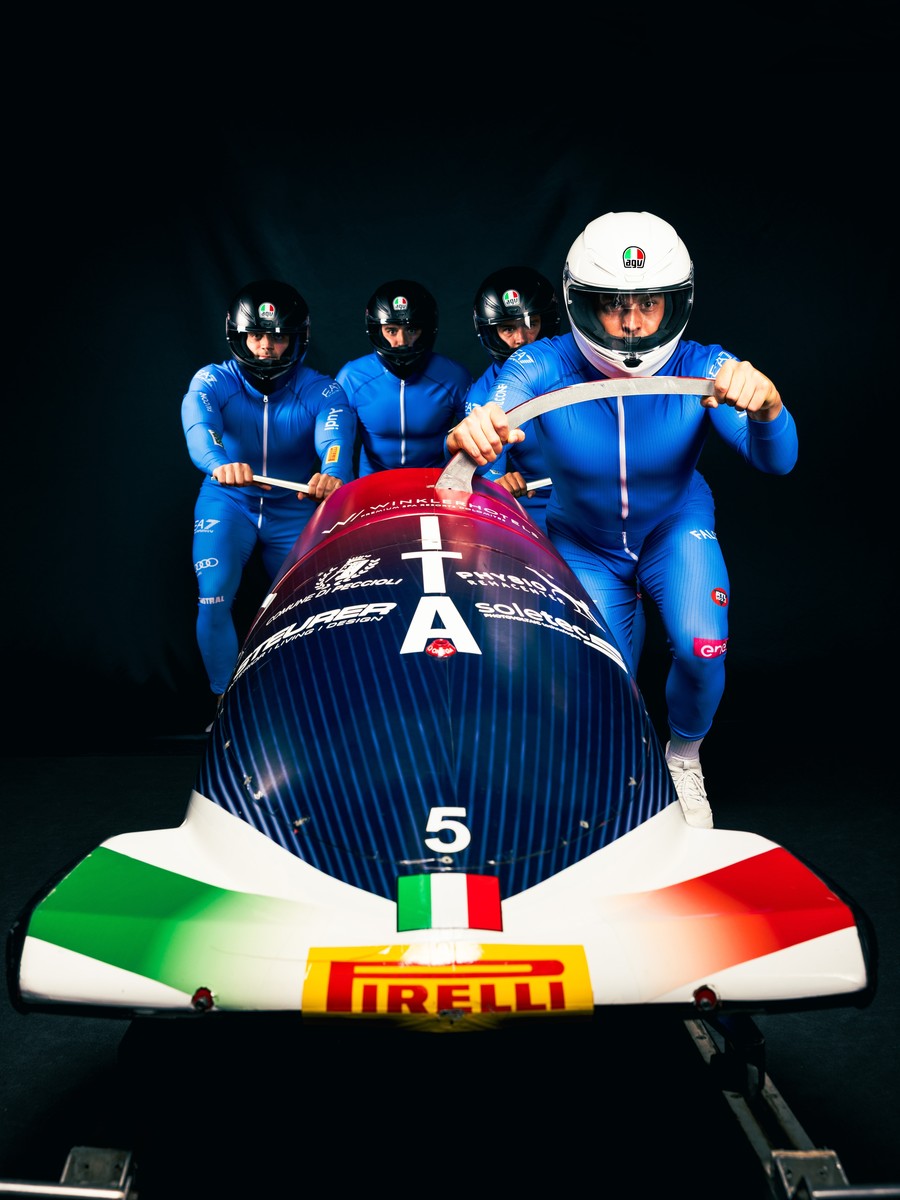
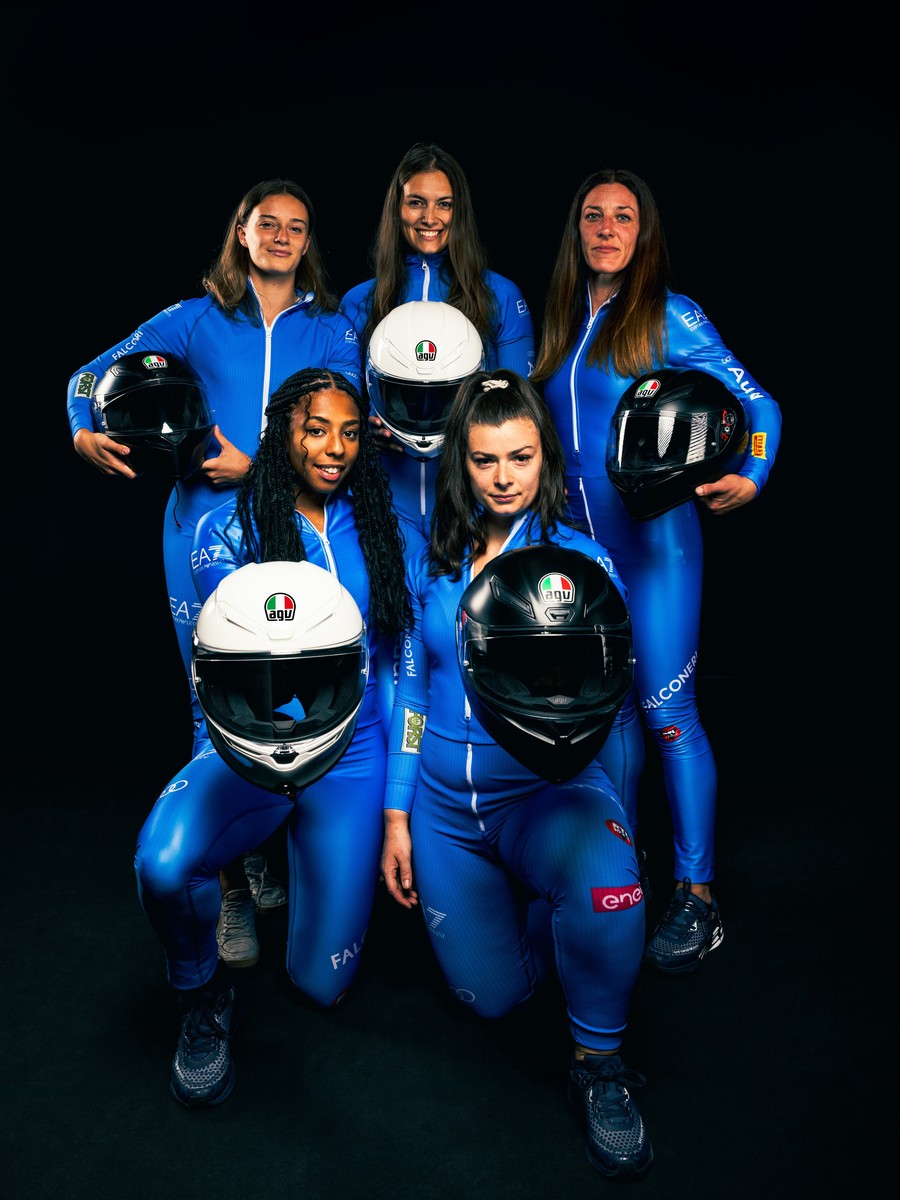
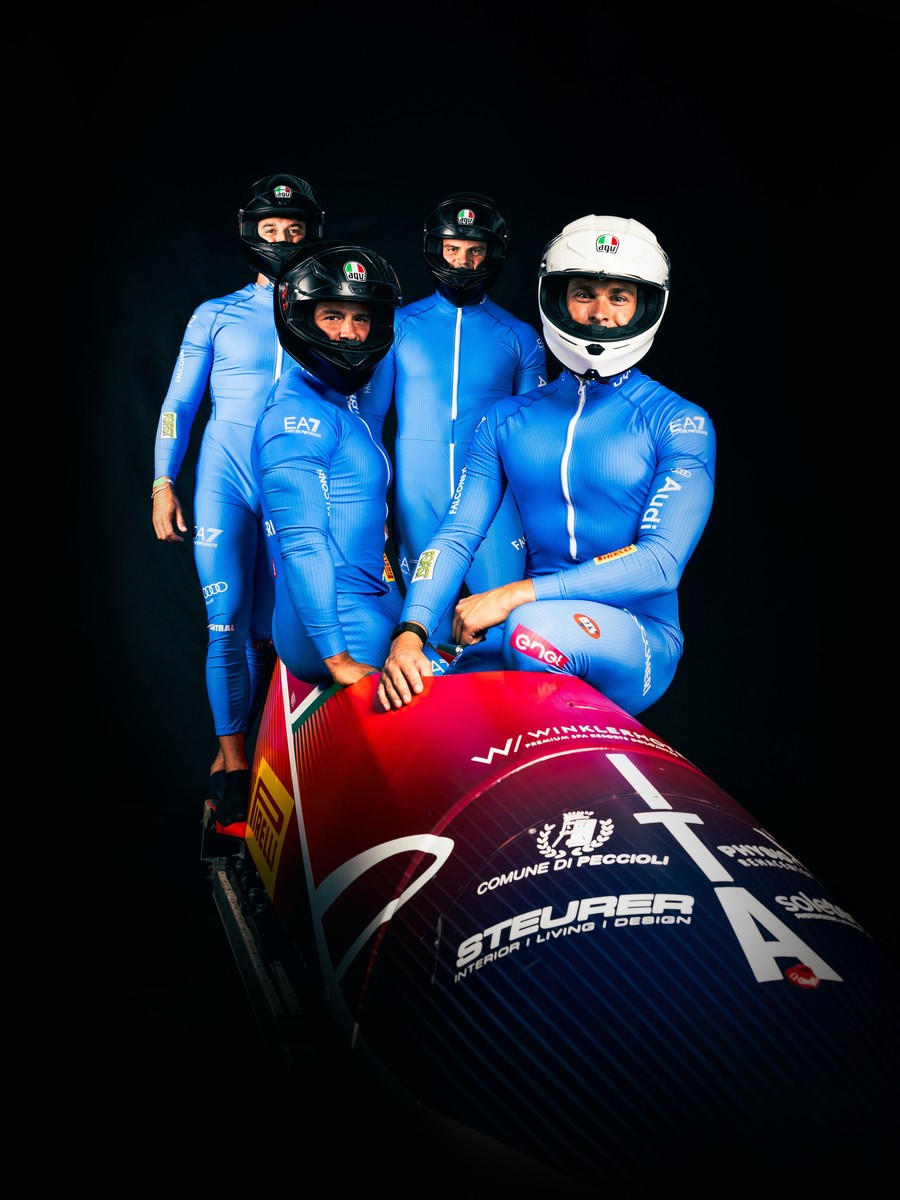
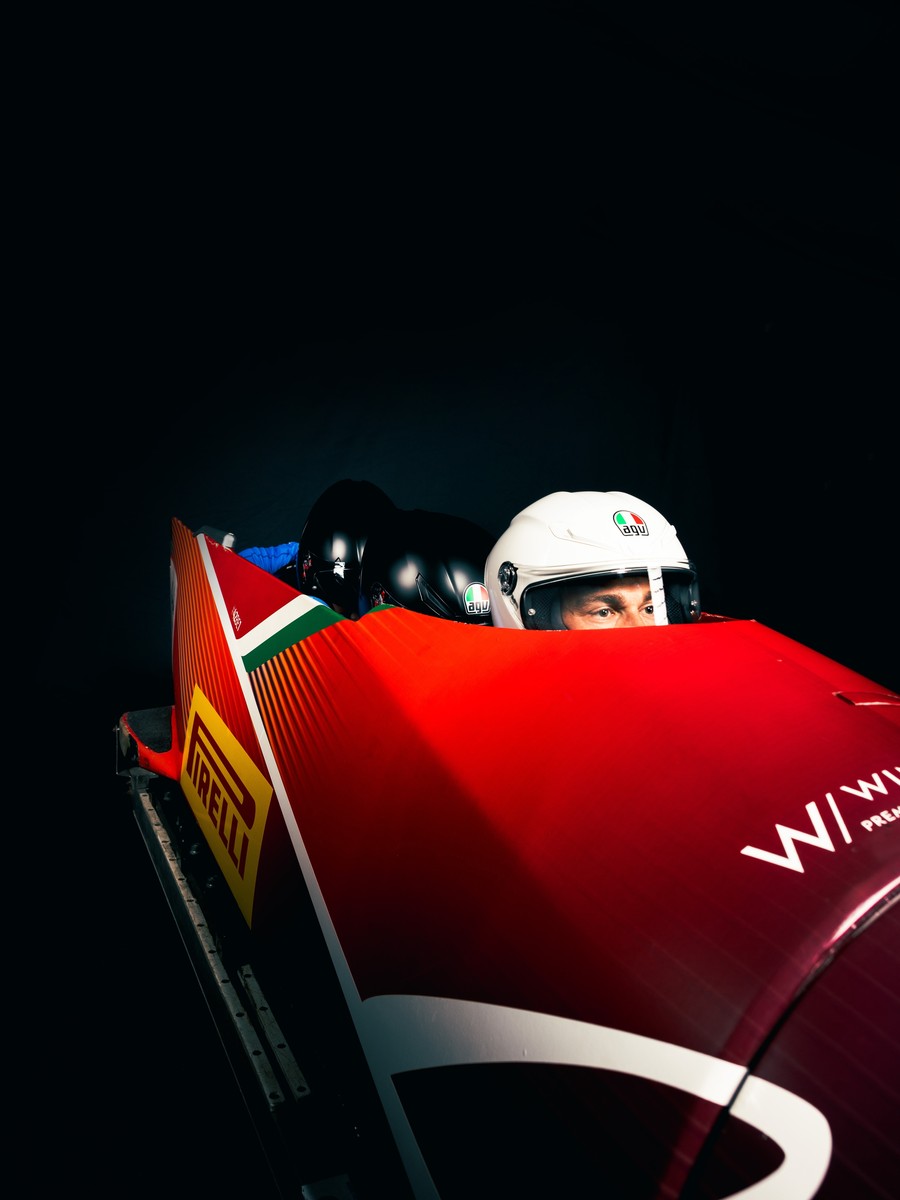
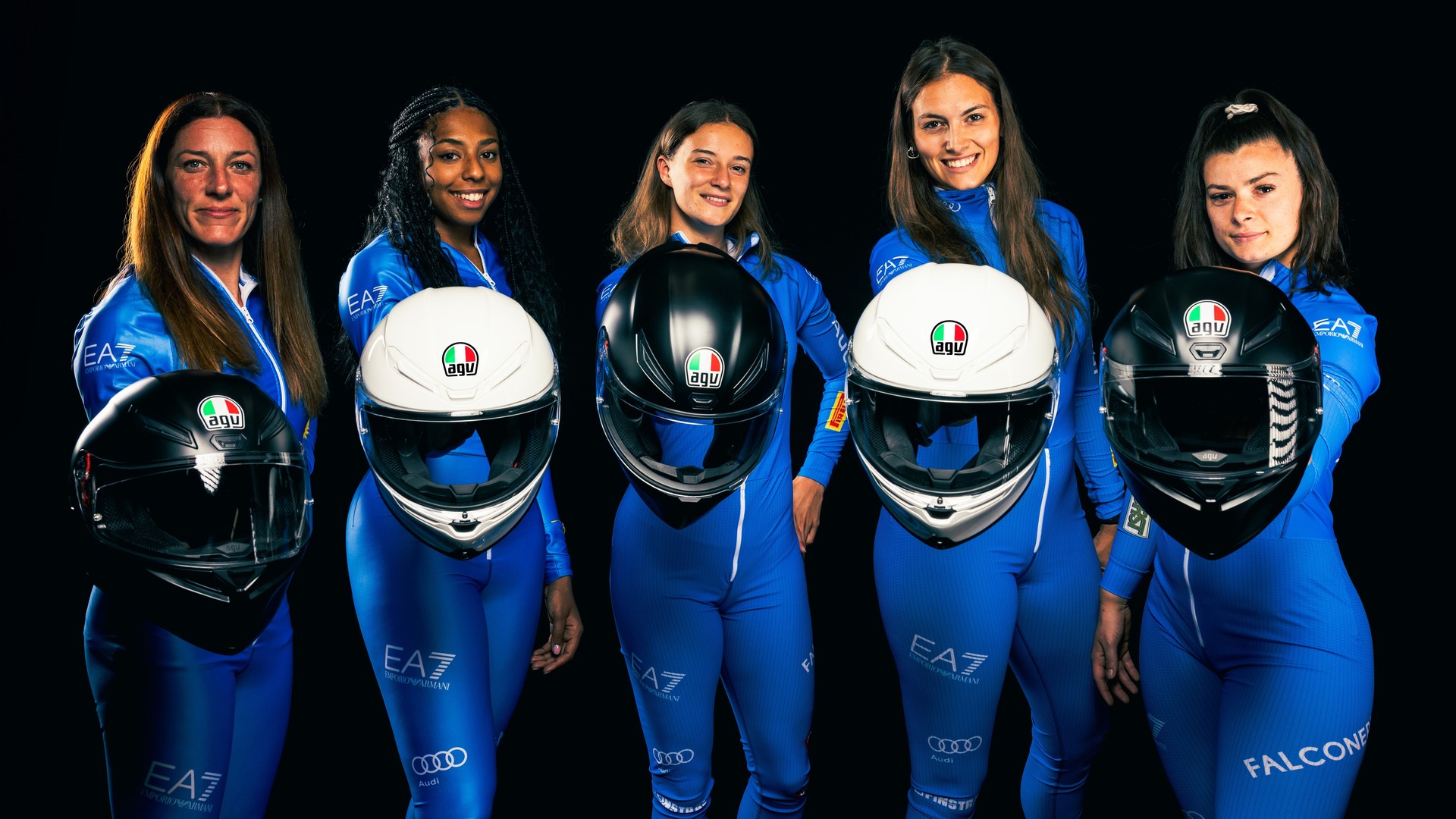
In pursuit of a higher level of safety, the Dainese group bas been supporting the Italian national bobsleigh team since 2023 by providing athletes with AGV full-face motorcycle helmets, essential for coping with the increasing speeds encountered on the runs, regularly well above 100 kilometers per hour. This is a push for better and more effective protection, but also to take care of performance from every perspective – motorcycle helmets feature efficient aerodynamics and a wide field of vision compared to other helmets.
An Olympic sport since 1924, bobsleigh is a less popular discipline, partly due to the small number of tracks available – just one in Italy currently – but that makes it even more fascinating to discover and explore.
We had the chance to have a chat with three members of the Italian national team, specifically with athletic fitness coach Giovanni Mulassano, monobob and two-woman bobsleigh driver Giada Andreutti, and four-man bobsleigh brakeman Lorenzo Bilotti. We asked them to explain the fundamentals of this sport, to understand the challenges and pitfalls athletes have to face, and the performance, skills, and preparation needed to compete at the highest levels.
Giovanni Mulassano answers the first question, with a wide-ranging perspective resulting from a decade of experience first as an athlete and then as a coach – how does the sport of bobsleigh work?
Let’s start with the crew members – one in monobob, two in two-man bob, four in four-man bob. The bobsleigh starts from a standstill. There’s an initial untimed 15-meter section before the first photocell when you push. Then there’s zero and a whole series of photocells afterwards to detect intermediate times and speed.
The crew is aiming for a standing start with maximum acceleration, which is why the athletes need considerable explosive strength. Then there’s the sliding phase, when only the driver acts on the controls, in particular with a steering system that moves the front runners.
The rest is simple – whoever completes the run in the shortest time wins. Races are usually run over two heats with the times added together, but the most important races such as the Olympics and World Championships are run over four heats.
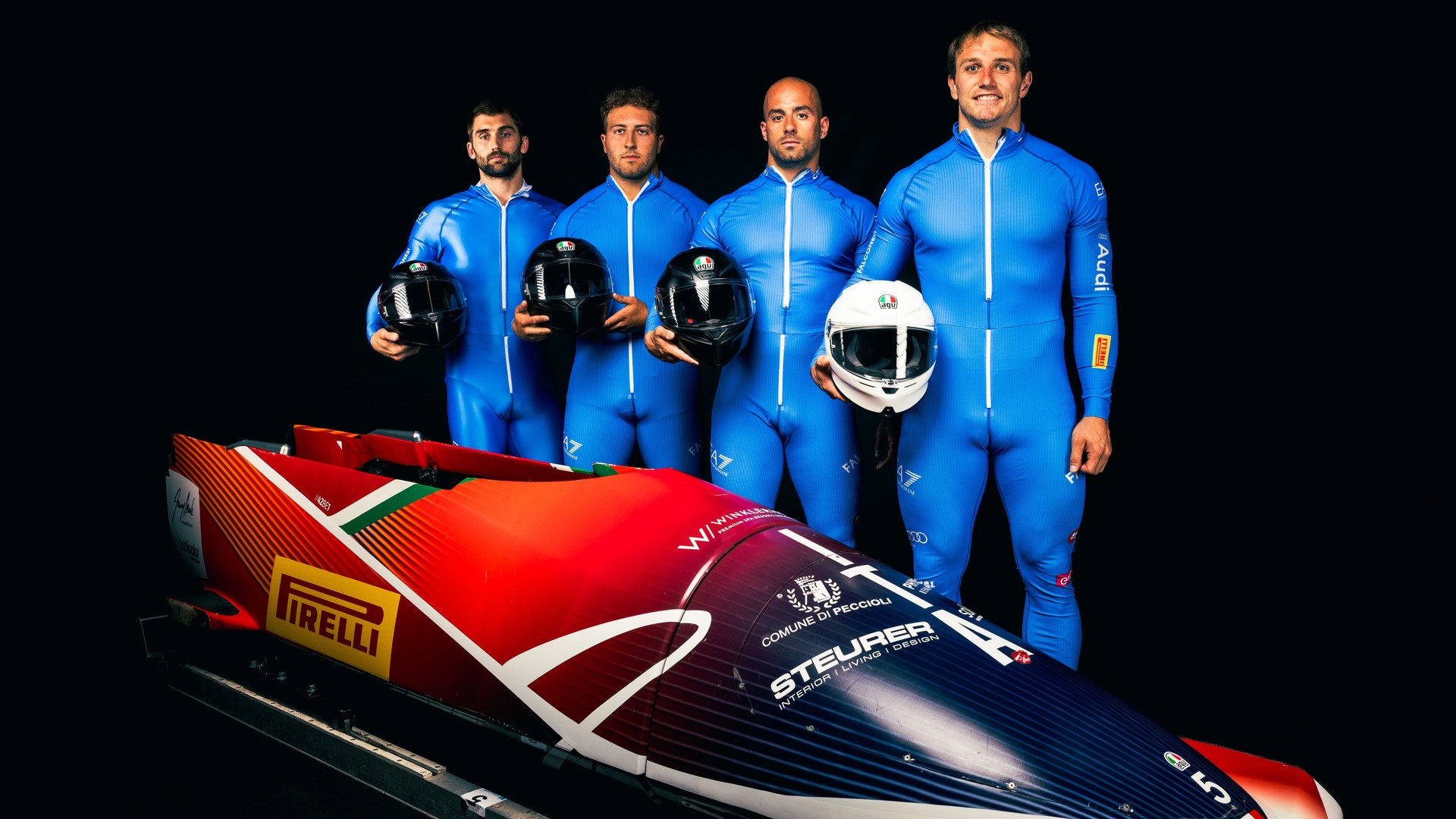
We turn to Lorenzo – what are the roles of the crew members?
At the start, everyone pushes. Then there’s the driver, alone on the monobob. In the 2-man and 4-man bobsleigh,
the people at the back are called brakemen. In the 4-man bobsleigh, the second and third are generally heavier, explosive, and able to reach major peaks of speed quickly. They don’t have a specific role during the run, but the position they assume is important for optimizing the aerodynamics.
Now a question for Giada, the driver – what makes bobsleigh unique?
From the driver’s point of view, the physical and mental dualism between pushing and driving is interesting, moments that require very different types of effort. Once the moment of pure power is over, we need to reset, relax, and drive with calm and precision. Every little vibration can lead to imperfections in driving and therefore loss of time.
Like in motorsports, speed and therefore adrenaline play an important role. But there’s no engine here, and I think that makes it even more fascinating. Bobs are vehicles that have to be “put in motion” by human strength alone. You have to consider that a 4-man bob weighs 630 kg when fully loaded, while we women have to push a 163 kg monobob on our own.
Giovanni, what’s the most common mistake made by people who watch a bobsleigh race without knowing it?
Many think that it’s much easier than it really is. They think that there are predefined trajectories, believe that once on board you don’t do anything anymore. But driving is actually very important for speed, after the push, which in any case is no small matter if you want to achieve an excellent level. It’s like riding a motorbike on a track. Just doing it is basically pretty simple, but doing it at a high level is another thing entirely.
Lorenzo, what does a good run depend on?
The most important elements, as we said, are the start, then coordination when pushing, the athletic fitness; skill in getting on the bobsled is fundamental as well, extremely important for maintaining the speed achieved during the push. If there’s too much of a gap at the start, it’s very difficult to recover. In a time of around 1 minute, the final gaps between the best crews are hundredths, at most a few tenths.
Then there’s the run itself, which depends on the materials and driving. The whole sport was once heavily unbalanced and focused on driving, then there was a technical evolution in materials, the tracks were made safer, so even in extreme conditions, the bobsleigh stays on the runners, and that’s when the bobsleigh as a vehicle gained more importance. But if you make a mistake, of course, you lose speed, so the driving component remains.
Giada gives us the driver’s point of view: The right mental training, visualization of the track and analysis of the curves are also crucial; you have to consider that the ice changes from one day to the next depending on the weather conditions. You need to evaluate that and adapt your driving accordingly.
Again, we ask Giada – what controls are in the bobsleigh? How much is really under the crew’s control?
There are two handles for steering that move the front runners, which direct it, while the rear ones are stationary. You pull the right handle to go right and vice versa. The force we apply determines how much we steer.
Giovanni, how do you train?
Bobsleigh is quite a complicated discipline. The basic training is a mix between a track and field sprinter and a weightlifter. The fine-tuning involves finding the right balance between the two. But the preparation we do in summer also has to allow us to be at our best for a long period lasting the whole winter.


Let’s talk a little about a topic close to our heart at Dainese – clothing and protectors. What do you wear on board the bobsleigh and how do you get dressed?
We have a suit that covers us up to the wrists and ankles. It’s a technical material that allows us to stay warm, but above all to be aerodynamic. The dressing ritual is subjective, but generally you wear a thermal shirt, a Kevlar safety vest that protects against abrasion and cuts in the event of a rollover. That has only been mandatory for two seasons.
Then there’s the helmet, increasingly important. You have to consider that speeds have been increasing slightly in recent years. There have been speeds of 158 kilometers per hour in Whistler, Canada, even if that’s the only track with those speeds; in Cortina you still reach 130 km/h. A full-face helmet is mandatory, almost always a motorcycle helmet, because it offers an optimal field of vision. Then, for the driver, the choice of visor – clear or dark – is fundamental, and then you need the internal Pinlock visor, to avoid fogging. The aerodynamics of the motorcycle helmet is also an important element, especially for the driver, who is the most exposed at the front.
Then there are the spiked shoes, like athletics shoes in shape, but with a hundred and fifty 3 mm spikes at the forefoot planted into the ice, helping to avoid indecision during the push.
What are the main risks during a run?
When cornering, there are very significant stresses, with compressions that can even reach 5G. Then you can always overturn and if you make a mistake there’s no gas or brake for correcting it. On a motorbike you can ride for long distances, brake and stop, or slip and stop after a few meters. There’s the possibility that we ride the entire track under the bobsleigh, in which case the Kevlar vest and helmet can save you, from both injury and abrasion. You also have to consider that the helmet, even in normal conditions, often hits the hull of the bobsleigh.
What sports do new athletes usually come from?
Often from athletics, especially from sprints, then throwing, jumping, and lifting sports are the most common.
What is the most fascinating track in the world?
We think Cortina is the most fascinating. Sankt Moritz is wonderful as well, built entirely of ice, and rebuilt from scratch every year.
Bobsleigh remains a niche sport, but what it demands from athletes is anything but secondary. Behind every run there are preparation, materials and technical choices that make the difference. But, as in all speed sports, the protection component is also fundamental to ensure that athletes feel safe and able to give it their all. After all, you have to put in maximum effort on the track if you want prestigious results, because, as with motorbikes, “just doing it is basically pretty simple, but doing it at a high level is another thing entirely”.