LIFE IMPACTO is a cutting-edge solution designed to change the linear life cycle of motorcycle helmets, addressing the challenges of how to dispose of these sustainably and creating a circular process based on selective dissolution recycling.
The project is co-funded by the European Community as a result of winning the LIFE23 subprogramme Circular Economy and Quality of Life call to tender.

Co-funded by the European Union. Views and opinions expressed are however those of the author(s) only and do not necessarily reflect those of the European Union or CINEA. Neither the European Union nor the granting authority can be held responsible for them.

BE PART OF THE CHANGE

Don't throw away your thermoplastic helmet, give it a second life.
Whatever the brand, bring it to a selected Dainese store.
We extract and transform plastic materials to create new sustainable products.
Reduce your environmental impact, don't waste the opportunity. Find your nearest Dainese store now.
FIND THE NEAREST DAINESE STORE NOW
When you drop off your old helmet in store, you will immediately receive a 20% discount on the purchase of a new helmet.
Limitations apply. The discount cannot be combined with other promotions and is valid only at the store where you drop off your old helmet, and only on the same day.
THE PROJECT IS BEING ROLLED OUT BY A CONSORTIUM OF FIVE ITALIAN COMPANIES:
Dainese Group in the role of coordinator

Innovando, an innovative SME specializing in reverse logistics
Re-sport, a start-up spin-off from the University of Bologna which is focused on innovative technologies for recycling composite sports equipment

Misitano&Stracuzzi suppliers of bio-based solvents extracted from citrus fruit waste
Università di Bologna for the research and development component of the project
THE PROCESS
LIFE IMPACTO is based on an innovative plant which enables the separation of the different plastic materials of which the helmet is composed, through the action of bio-based solvents (limonene and ethyl acetate) obtained from food industry waste.
In this way, the key plastic materials (ABS, EPS and PC) can be recovered and reused within the same value chain.
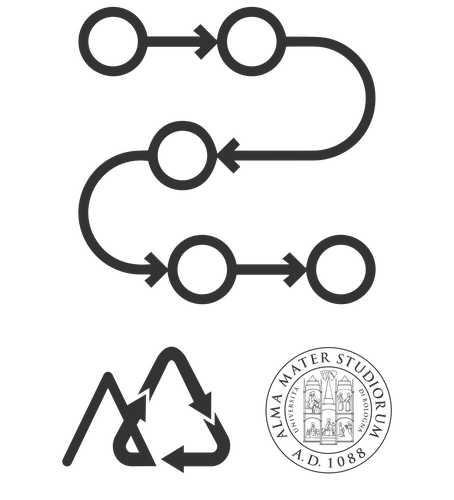
USED HELMETS*
LOGISTICS
RECYCLING PLANT
NATURAL SOLVENTS
(Limonene and ethyl acetate)
SECONDARY RAW MATERIALS
Recycled ABS from the outer shell
Recycled EPS from the inner shell
Recycled POLYCARBONATE from the visor
Recycled FABRIC from the interior
* Some of the helmets collected will be used in the research and development of a new, type-approved, environmentally-friendly helmet model.
THE GOAL
The goals of this ambitious and innovative project are:
• to develop a proactive approach to the management of end-of-life products, preventing them from becoming waste;
• to establish a sustainable and efficient process for separating and recycling the polymer materials used to make the helmets;
• to use recycled materials to manufacture new helmets or other "green" products.
Some of the used helmets collected will be used in the research and development of a new, type-approved, environmentally-friendly helmet model, designed according to the principles of design for recycling.
Without ever losing sight of the ultimate goal: to ensure maximum safety of riders in all conditions and at all times.
THE RESULTS
To give an idea of the scope of this revolution, with 5,000 recycled helmets, 3,700 kilograms of ABS, 1056 kilograms of EPS and more than 600 kilograms of PC can be obtained. This process leads to a real, tangible benefit for the environment, with a 60% reduction in CO2 emissions, a 60% reduction in electricity consumption and a 50% reduction in water consumption.
Life Impacto is also opening up new job opportunities in two of the consortium bodies, Dainese Group and Innovando, creating a positive knock-on effect on employment.
The ultimate goal of this ambitious project is to introduce a homologated, environmentally-sustainable helmet model to the market, conceived and designed according to the design for recycling approach, without the use of glues and with a reduction in the variety of materials used, as well as greater ease of breaking down the various materials when these are recycled.
Some of the used helmets collected will be used for the research and development of the new helmet model.
5.000 HELMETS
3.655 kg
ABS
1.056 kg
EPS
637 kg
PC
-60% of CO2 emissions *

-60% of electricity consumption *
-50% of water consumption *

+1 approved eco-sustainable helmet model

+2 new job opportunities
*linear economy vs. circular economy