

 Motorcycle: BMW R100 GS del 1991, di nome Utopia
 Mileage: 900 km
 Difficulty: media, ho incontrato sia asfalto che fuoristrada. Quest'ultimo può essere impegnativo per un principiante e facile per un pilota esperto
  Duration: 9 giorni
 Time of the year: Novembre
 Weather: variabile
 Temperatures: attorno a 0°C
 Essential equipment: completo da moto invernale, abbigliamento impermeabile, stivali da fuoristrada, intimo tecnico per le basse temperature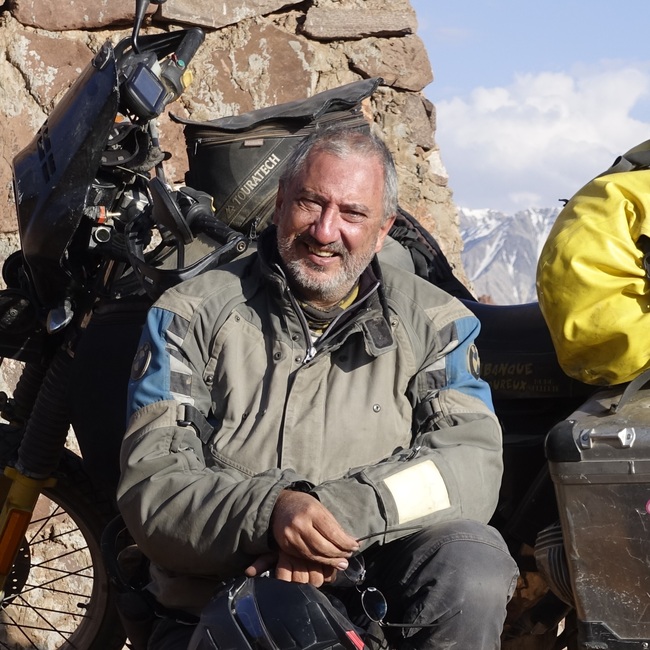
Jef Le Saltimbanque
The author
My name is Jean-Jacques, but when I travel I use the nickname Jef, in reference to writer-journalist Joseph Kessel, whose books fueled my imagination when I was a teenager, and since a nomadic life is a real lifestyle for me, I’ve decided to be Jef Le Saltimbanque. My father was an expat and I grew up traveling, in Turkey and in Portugal. During my lifetime, I’ve had several passions in turn – skiing, diving, underground diving, hot air balloons and, especially, horse riding. In 2003-2004, I took my first 16-month motorcycle journey through Africa. I wrote my first book about this adventure (The blue bandana: tales of a promise under the pen-name of Jean-Jacques Aneyota). In 2018, I returned to Asia for 16 months, and now I’m planning a trip around the world without any time limits. My role model is Hubert, who spent the last 14 years of his life traveling. And... Oh yes... I’m about to turn 60.
To begin with, my first real piece of advice is simply that the best motorcycle for traveling has to be your favorite motorcycle. In fact, all motorcycles are fine for traveling. Sjaak Lucassen completed a five-year world tour with a super sports motorcycle, a Yamaha R1. Juvena, who calls herself “the wandering wasp”, traveled for three years from Singapore to Europe on a Vespa scooter. To my knowledge, the Forwoods have been on the longest motorcycle trip ever: Over 16 years, together on a Harley-Davidson, they visited all the countries of the world, some more than once, for a total of about 500,000 km.
So, yes, ALL motorcycles are good to travel with, but – there’s always a but – some are better than others. This means that if you have to choose just one model, then you should get one that best suits the trip you’re planning. And here’s my second piece of advice, though it seems to contradict the first: The ideal motorcycle for traveling in Europe will probably be less suitable for crossing Africa, and vice versa. So, the first question to ask yourself before choosing a motorcycle is, where do I want to go? Under which conditions and for how long?
As far as I’m concerned, I took two long trips, each 16 months long, on an old 1991 BMW R100 GS. The first trip was a tour of Africa, in 2003-2004. The second trip took me to Asia, in 2018-2019. Now I’m getting ready for a journey around the world, for which I’m fitting a 650 cc BMW Xchallenge – I’ll tell you about my experience and the reasons for my choice below. I’m not saying that I have all the answers, everyone will have a different individual experience, but I hope to be able to offer some food for thought.
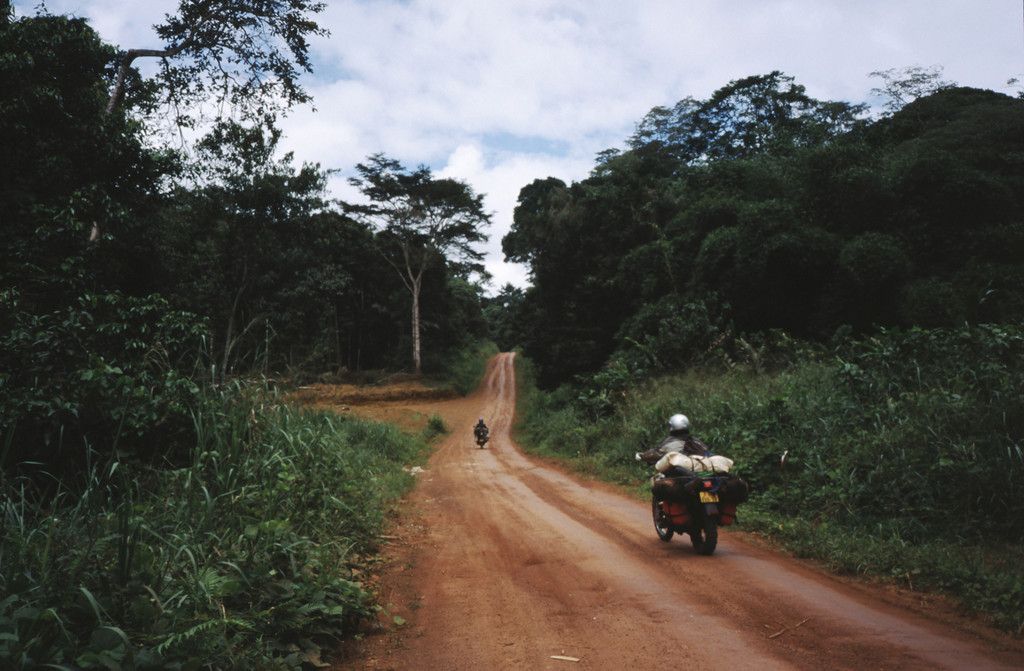
In Gabon in 2003
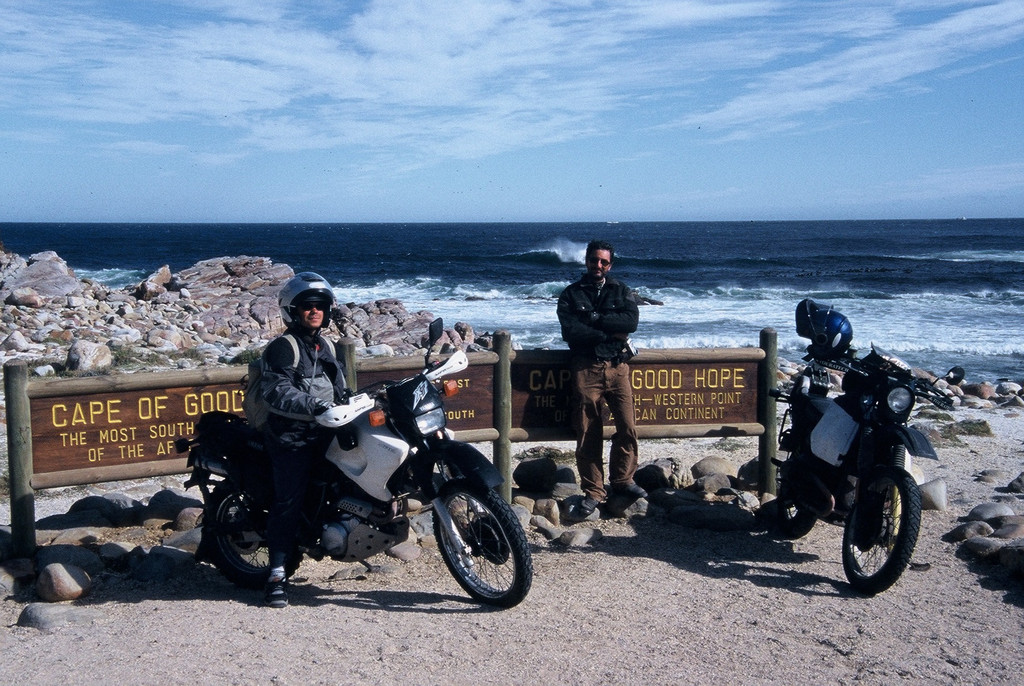
Cape of Good Hope
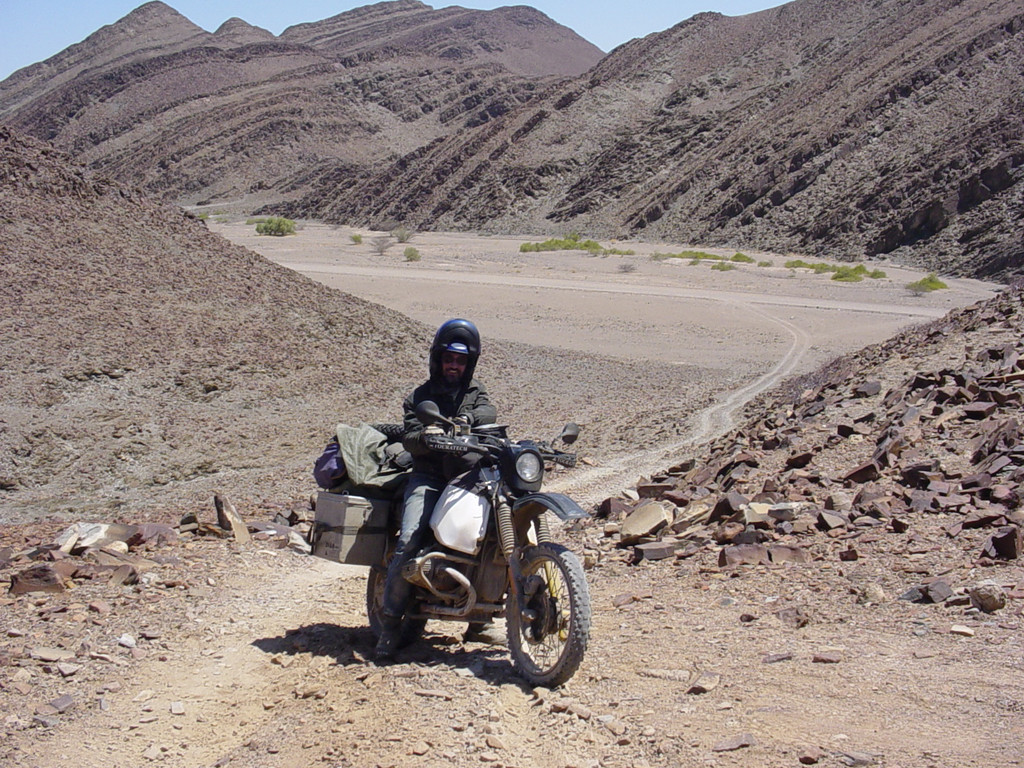
Namibia
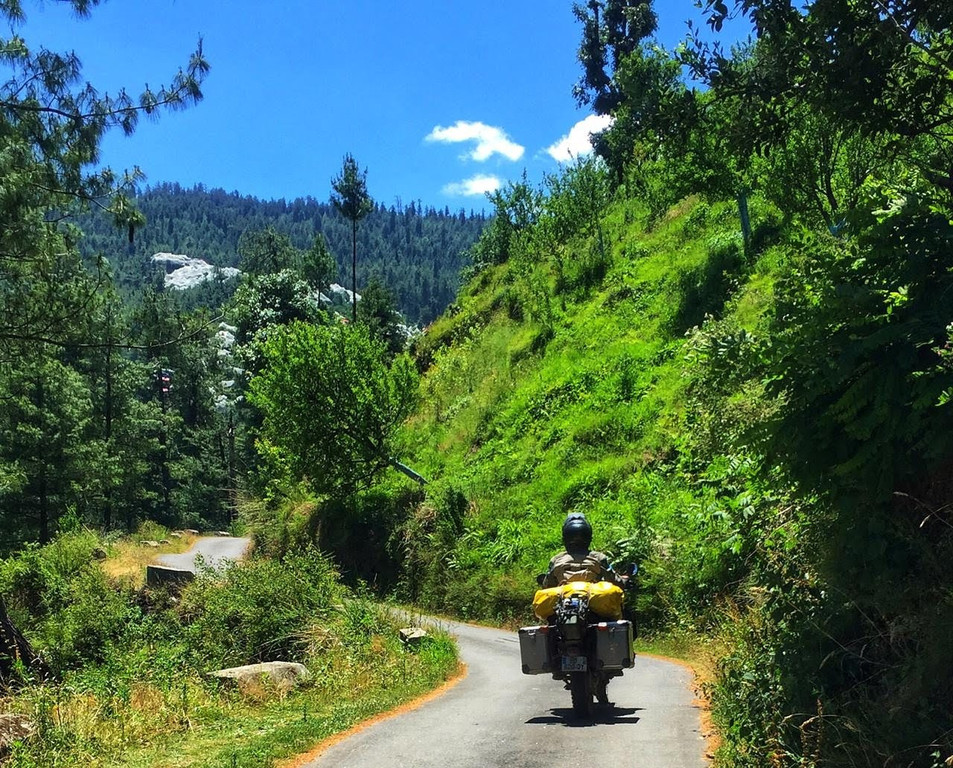
India, 2019
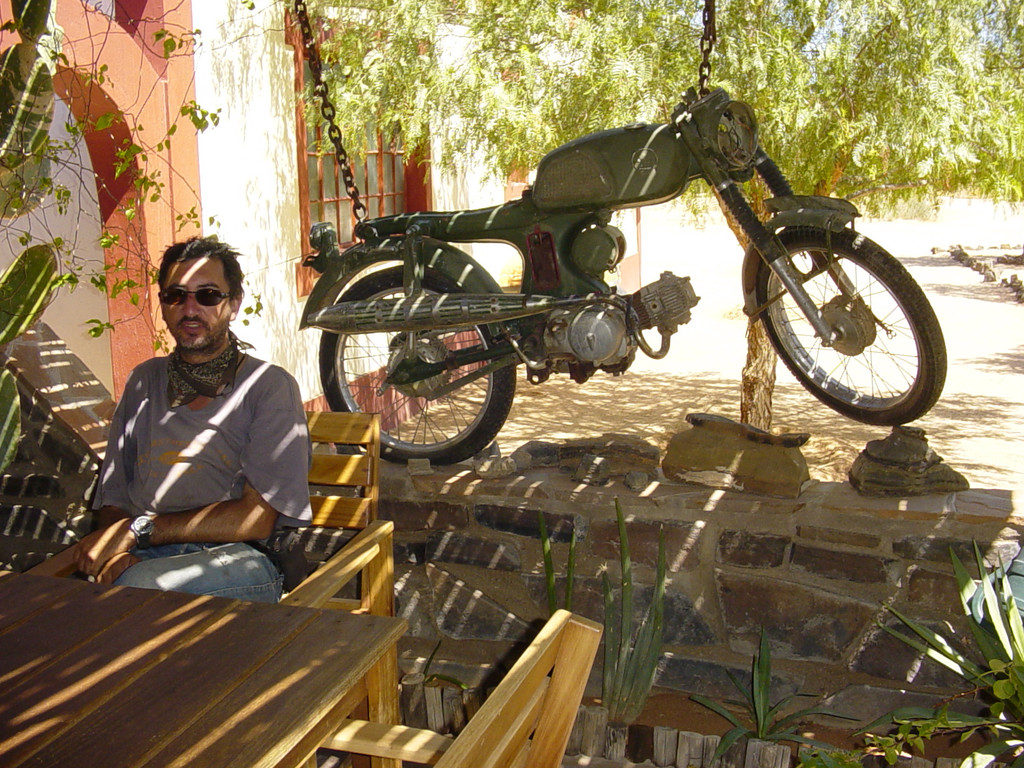
Namibia
The first trip: Tour of Africa in 2003-2004
At the time, I bought a BMW R100 GS, a 1000 cm³ twin-cylinder model with a 21-inch front wheel. I was actually looking for an R80 GS, 800 cm³, a little lighter but already quite difficult to find and therefore expensive. I’d also considered a Honda Africa Twin. What inspired me to buy the BMW was that this brand had long been used by the West African police and therefore I had presumably more chance of finding second-hand spare parts on the spot. And in fact, that’s exactly what happened: When I arrived in Ghana, it took me less than 48 hours to find a second-hand starter motor after mine gave up. Having said that, in hindsight, I actually think that the Africa Twin would have been more suitable and, above all, it would have required fewer alterations.
Let me share four important criteria with you, useful for choosing a motorcycle for long-distance travel:
- Availability of spare parts.
- Reliability of the motorcycle, especially in terms of engine.
- Spoked wheels rather than alloy ones (too fragile for dirt roads).
- Weight! While it’s true that, overall, roads have improved considerably in recent years, it can’t be denied that on a world tour you will inevitably have to learn how to ride on difficult stretches and trails. Let me assure you that, in those moments, you’ll find yourself cursing the manufacturers who, throughout the years, have simply decided to focus on making bigger, i.e. heavier, models.
Let me add a fifth criterion: If you plan to visit countries where customs require a Carnet de Passage en Douane (CPD), it’s best if the value of your vehicle is the lowest possible. That’s because depending on the country you want to visit, you’ll have to leave between 100% and 250% of your motorcycle’s value as a deposit at the local automobile association, and it can get expensive very quickly! That’s not all: If the motorcycle is stolen, you might not even get your deposit back.

Cameroun, my R100 and a Yamaha XT
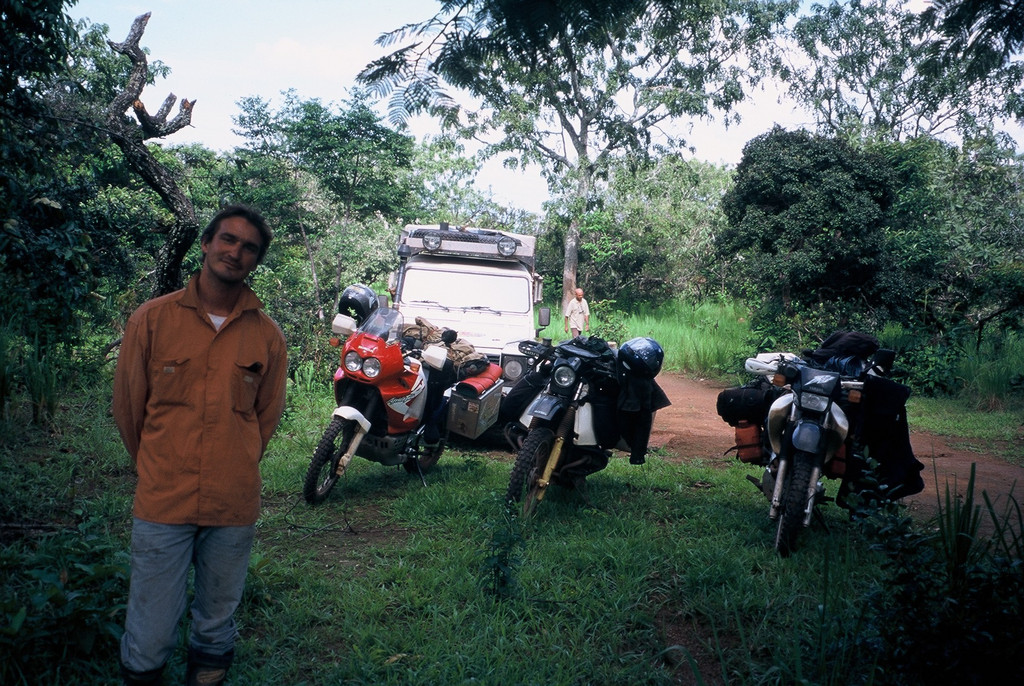
Cameroun, BMW R100 GS, my friend Jerome's Honda Africa Twin and Yamaha XT
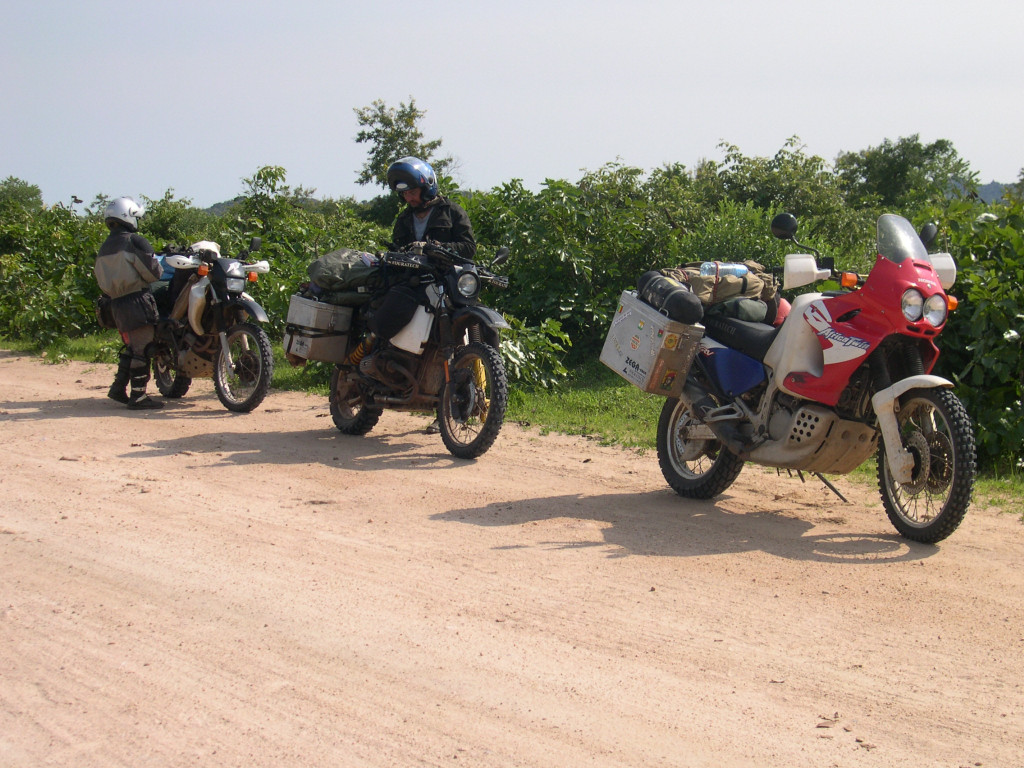
Cameroun, BMW R100 GS, my friend Jerome's Honda Africa Twin and Yamaha XT
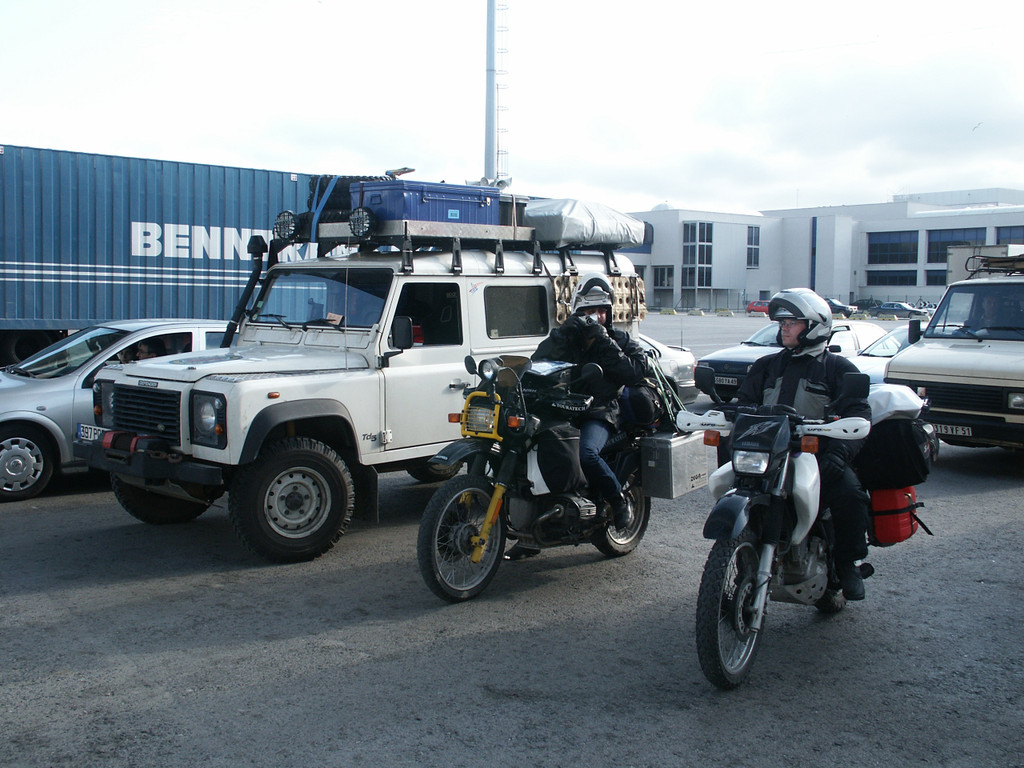
BMW R100 GS and Yamaha XT leaving
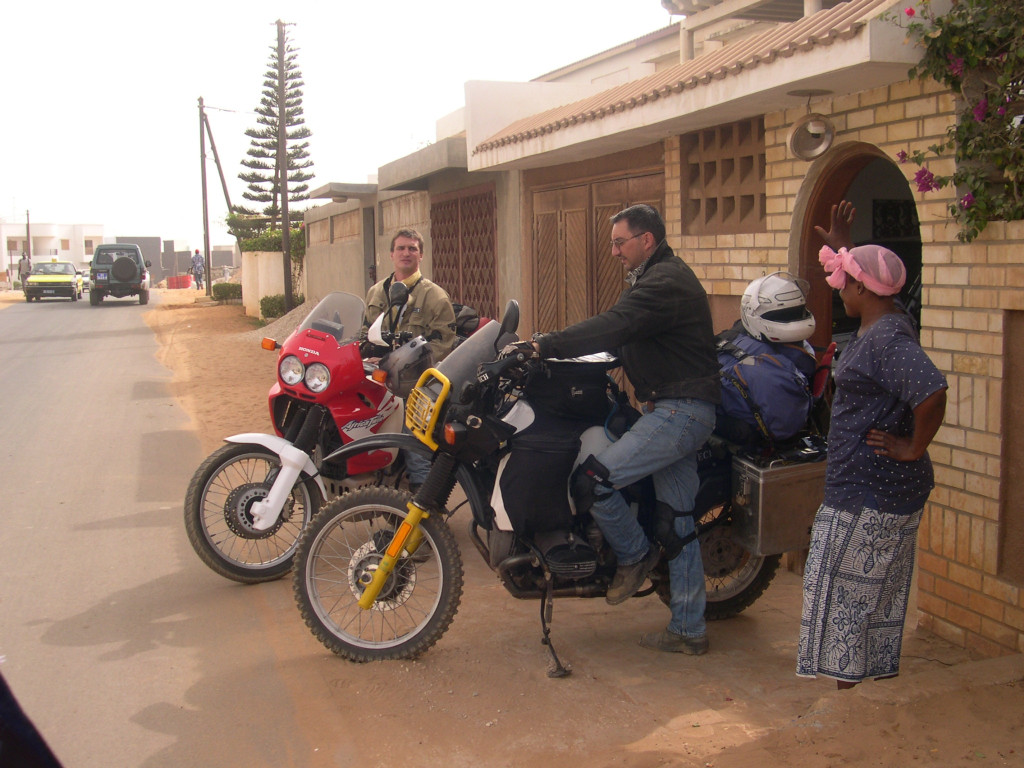
R100 GS and Africa Twin in Senegal
Advantages and disadvantages of my choice
After 16 months of traveling around Africa, here are the pros and cons of my BMW:
Pros:
- At a mechanical level, it’s simple and reliable; at the time I was a beginner, but I learned how to repair it quite easily.
- It’s not too difficult to lift by yourself, owing to the boxer engine’s two opposing cylinders that prevent the motorcycle from completely falling to the ground.
- The twin-cylinder engine’s drive torque makes riding really comfortable, as long as you don’t have to deal with mud.
Cons:
- The braking system, especially the rear drum brake. The rear brake is the main one used when riding off-road, so I definitely would have preferred a disc brake, which is more effective and works well even when wet, unlike a drum brake.
- A comfortable saddle. In the long run, riding had become a real torture. This is an extremely important point: That’s why I had a new saddle made for the second trip.
- Weight, weight, weight! Weight makes riding off-road difficult, especially in muddy conditions.
- Too large a displacement. On long journeys, power is not very useful. You never ride too fast, to safeguard both the chassis and especially the tires, but also for safety reasons. In many countries, drivers are not used to the acceleration or speed that these engines can reach, so they’ll just cut in front of you, thinking that you’re still far away and they have enough time to do so. In addition, a large displacement implies greater fuel consumption, therefore more fuel needed for a given range, therefore... even more weight.
Finally, here’s a summary of the mechanical issues I experienced during this first trip:
- I had to replace the steering and swingarm bearings
- Clutch plates. I replaced them in South Africa, and when I saw the condition they were in I couldn’t believe that the motorcycle was still able to move
- Shock absorber and universal joint (they both failed at around the same time after about 40,000 km – again, due to weight reasons)
- Push rod gaskets
- Starter motor (replaced with a second-hand Bosch one in Ghana, more robust than the original Valeo, where the vibrations caused the electrical contact to fail)
- Ignition leads
- Fork oil seals
I never had any issues with:
- The engine
- Chassis and wheels
- Electrical wiring
- The gearbox
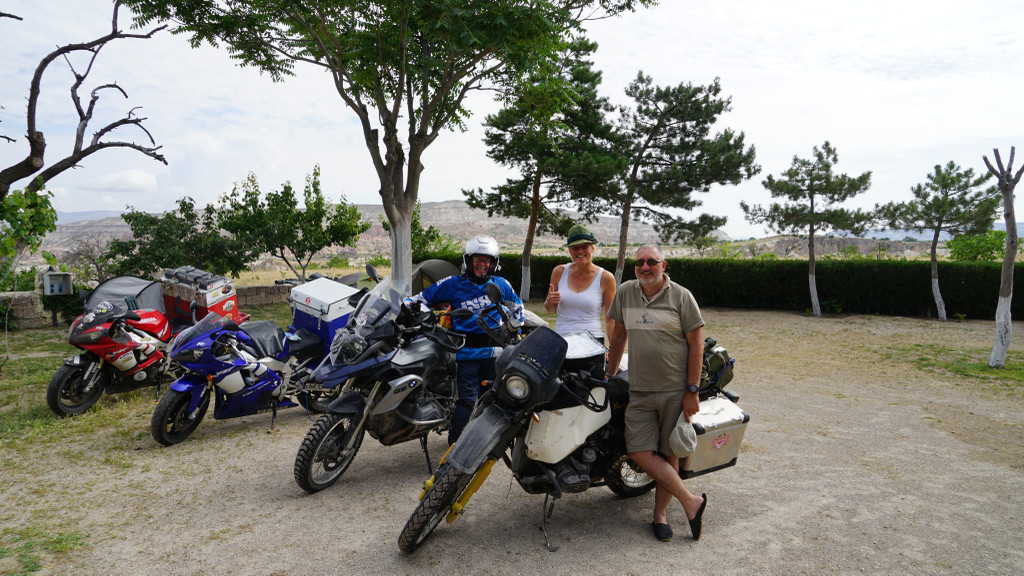
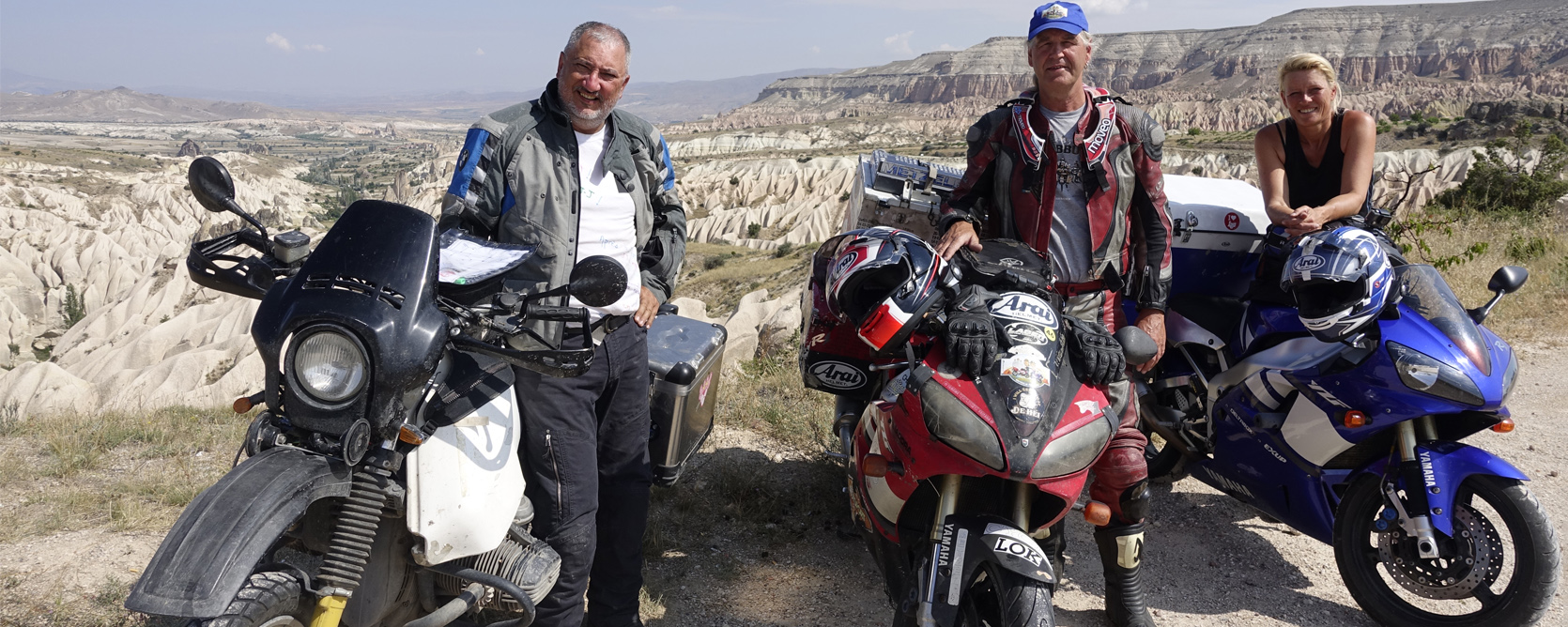
A well mixed team: my R100, a GS1250 and two sportsbikes Yamaha R1, the red one is Sjaak Lucassen's, a road trip legend
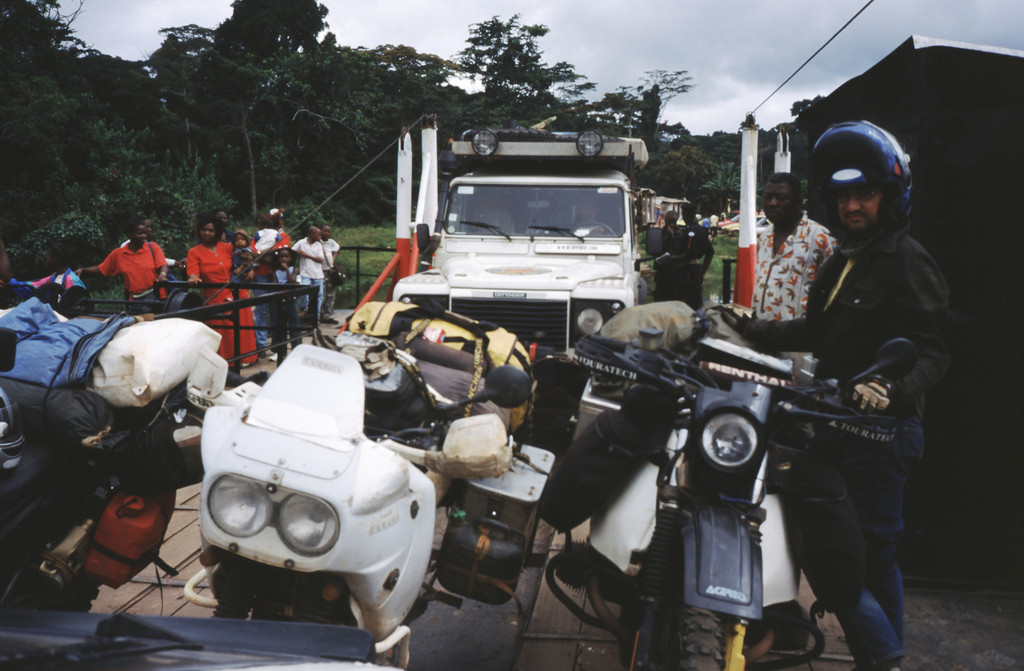
In Gabon in 2003, my R100 and a Yamaha Ténéré
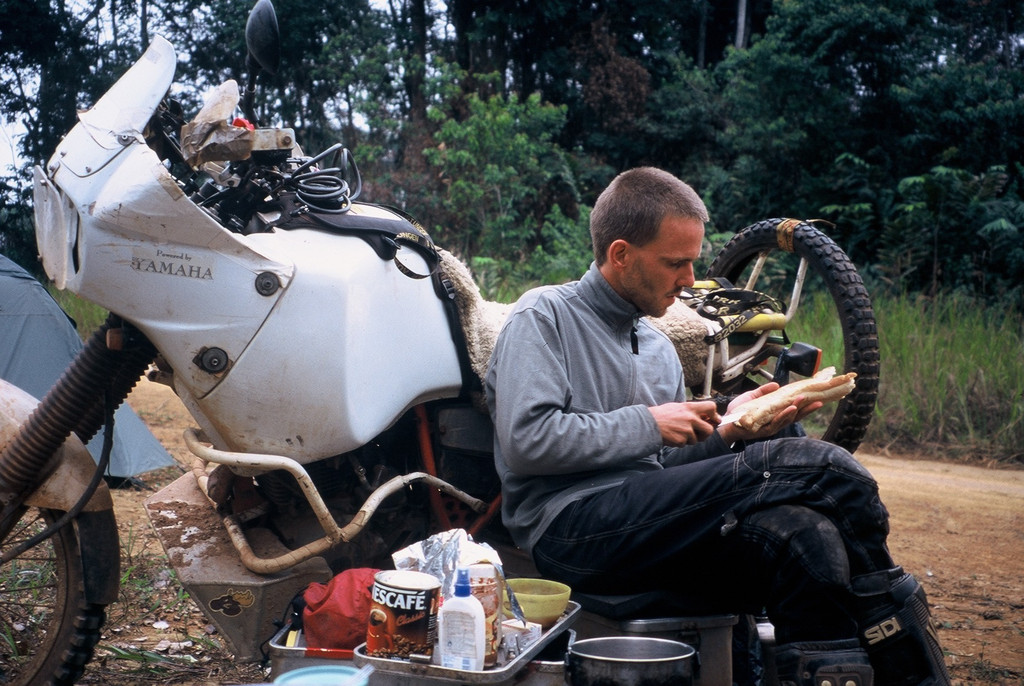
Gabon, Yamaha Ténéré 600
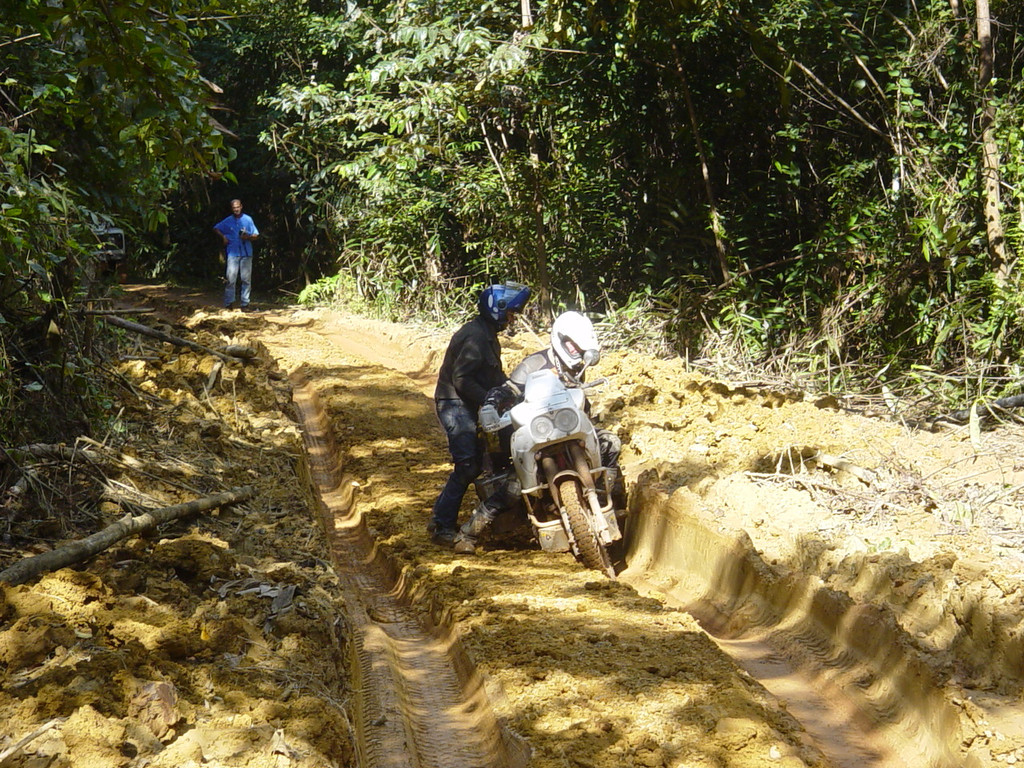
The Ténéré through deep mud
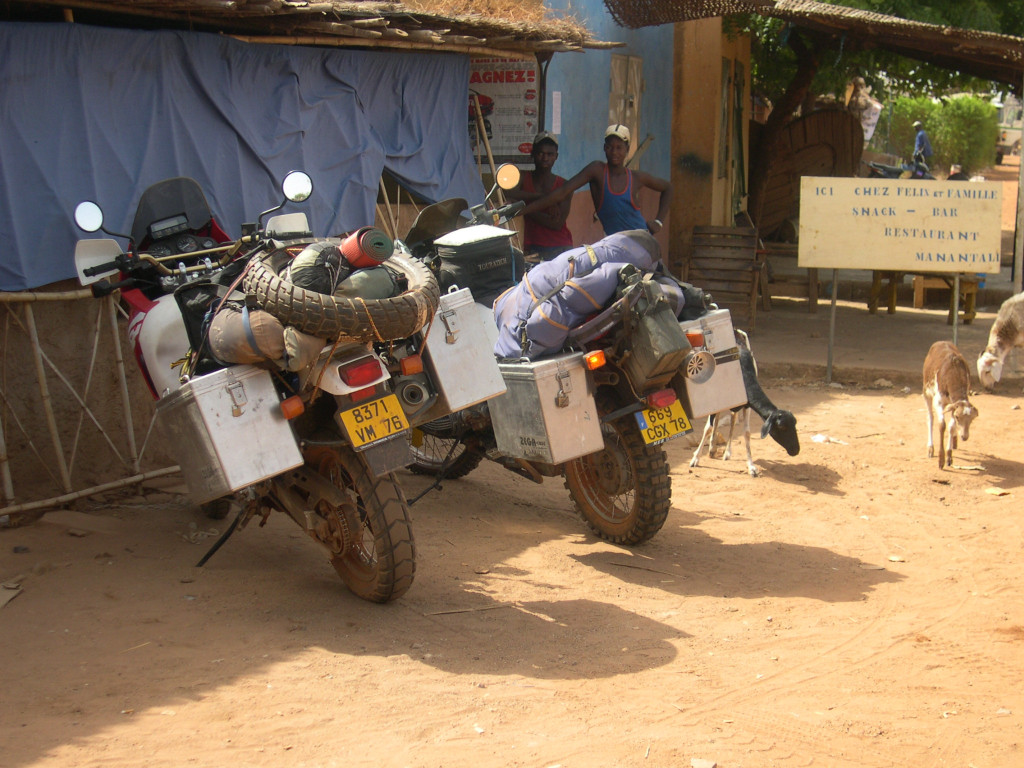
Africa Twin and R100 in Mali
My future traveling motorcycle
I won’t talk about the second trip, to avoid repeating myself. I left with the same motorcycle, my R100 GS, which had been completely disassembled and repaired before leaving. Just like the first time, weight was the main issue, especially on mountain passes with dizzying ascents. So much so that when I met a minibus on a very narrow road on the edge of a precipice I promised myself never to ride such a heavy motorcycle again. That’s why I decided on a new motorcycle for my next trip around the world. This time, my selection criteria included:
- Weight
- Reliability of the engine
- A displacement of less than 800 cm³, ideally between 400 and 650
- Price: The lowest market value I could find, to reduce the deposit required by the CPD (Carnet De Passage, a motor vehicle permit needed in some African countries)
- Availability of spare parts
- The possibility of traveling all over the world. This is both a subjective and a global criterion and includes long-term reliability and comfort considerations
I considered a Yamaha Ténéré 700, which weighs about 190 kg when dry. The average consumption, according to the manufacturer, is 4.3 liters/100 km, with fuel lasting for just under 400 km in the original configuration. To give you an idea, the dry weight of the R100 amounts to 210 kg, so I would gain 20 kg, a good amount, but not enough for what I want to do next – a journey through Africa on the dreaded Congolese tracks. Having said that, I think it’s currently one of the best motorcycles for long-distance travel. In addition, it’s equipped with a twin-cylinder engine that increases riding comfort. The only flaw is that it’s a very recent model and as such its market value is quite high, which can be a problem with the CPD deposit amount.
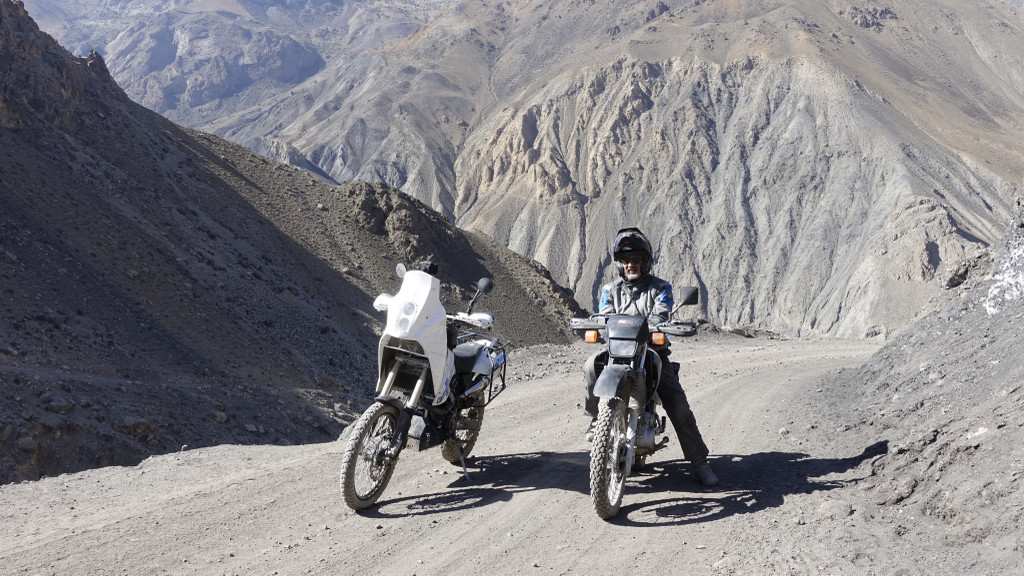
BMW G650 Xchallenge and Yamaha Ténéré
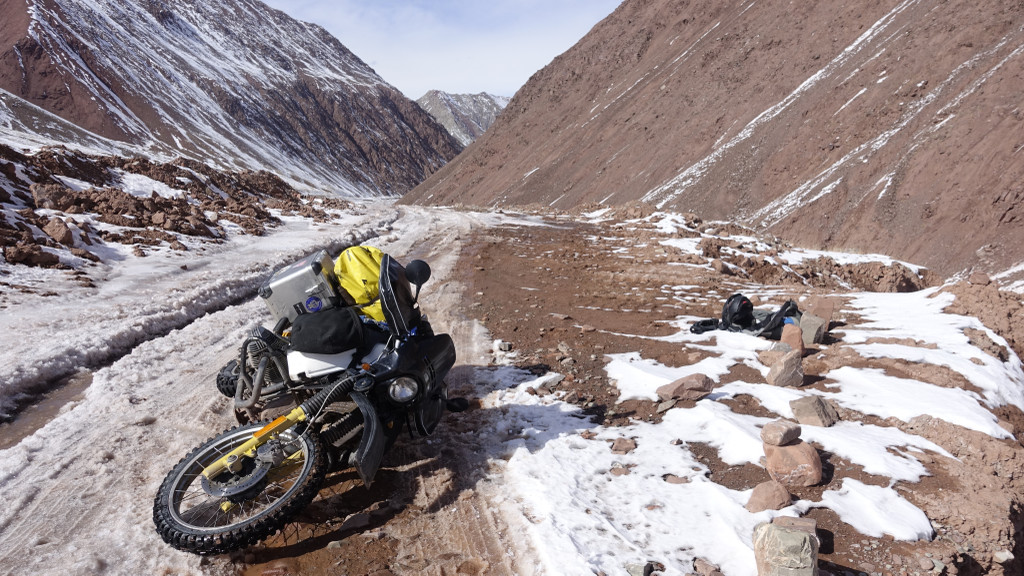
No man’s land between Kirghizistan and Tadjikistan on pamir Highway

No man’s land between Kirghizistan and Tadjikistan on pamir Highway
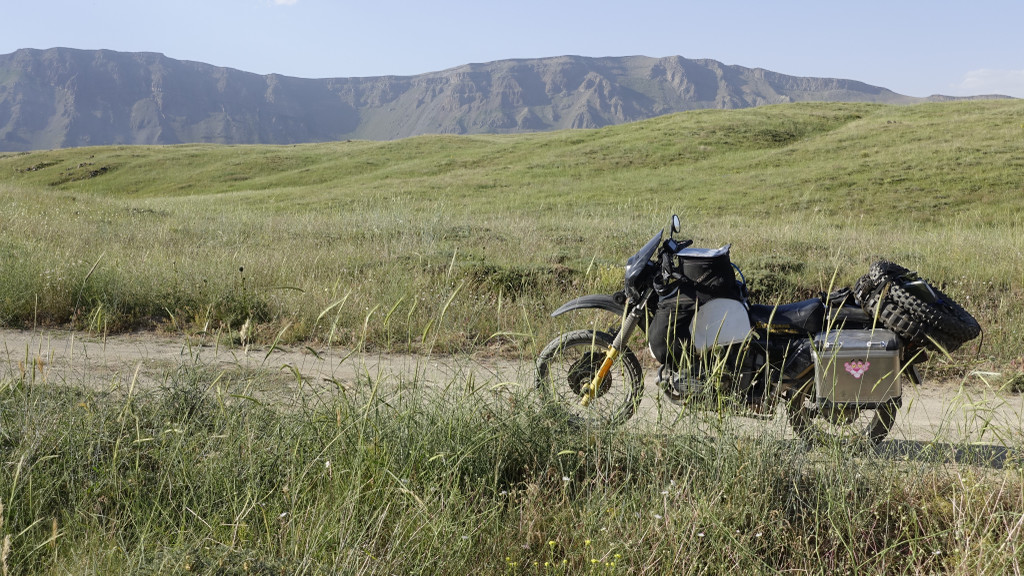
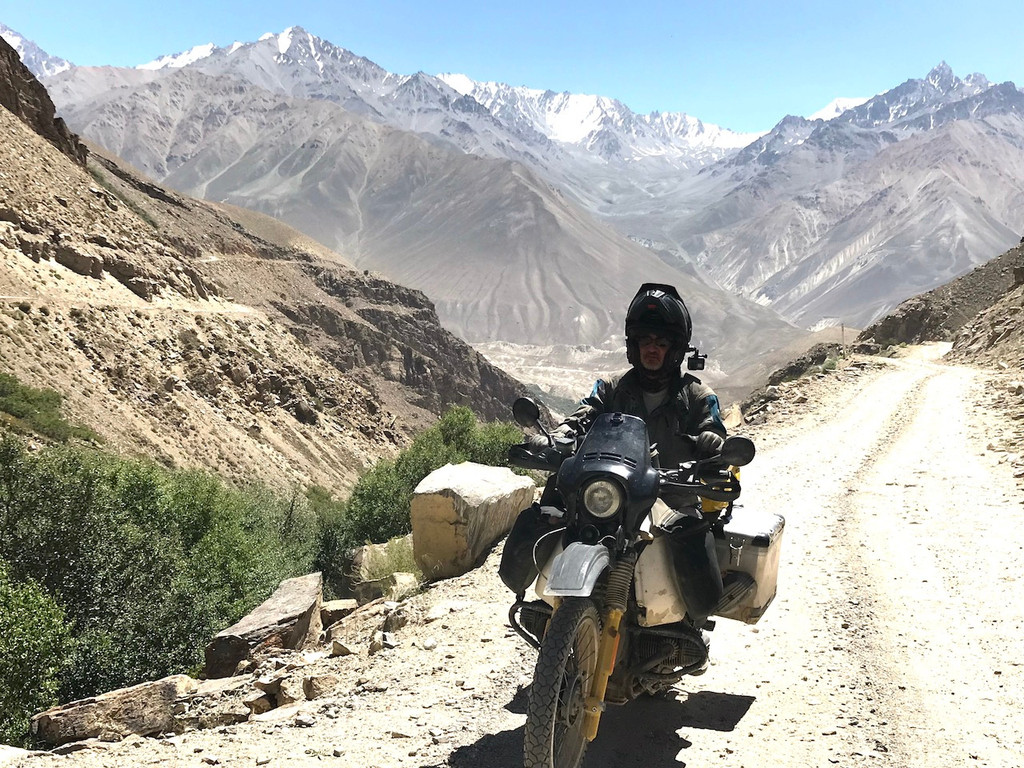
Pamir Highway
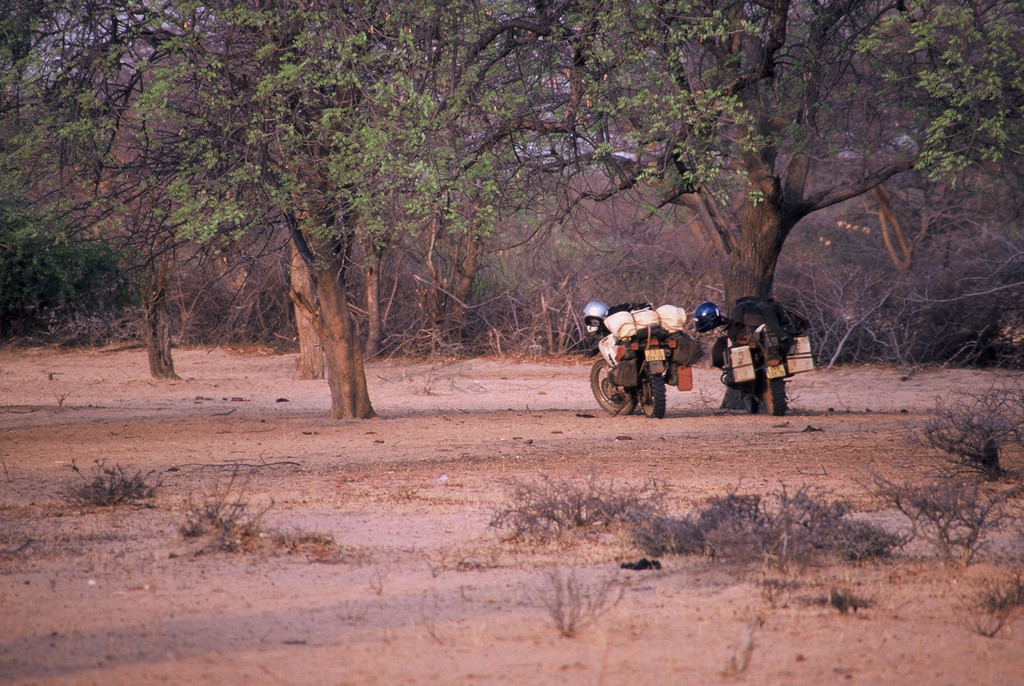
Angola, 2003
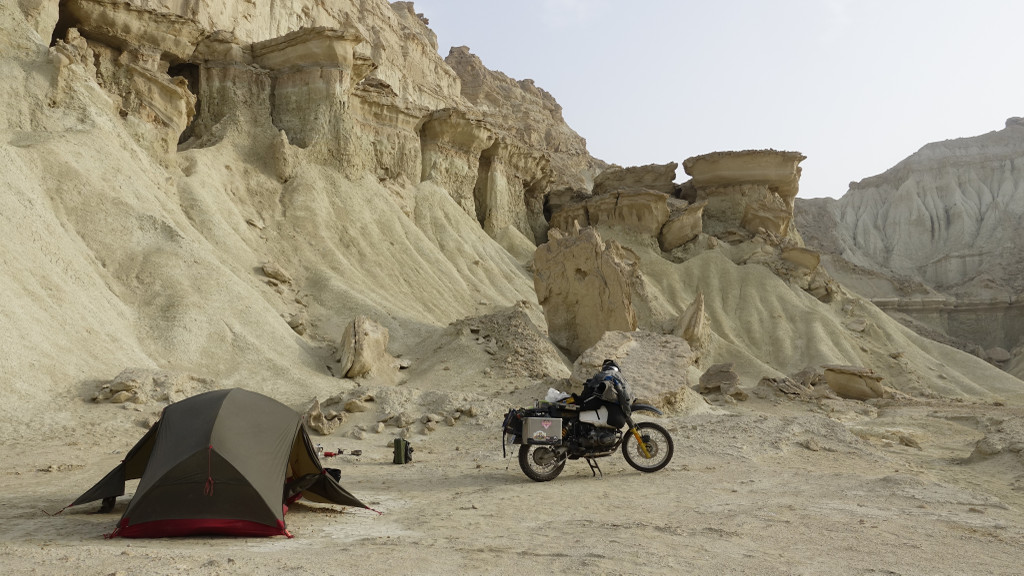
So, I thought I’d take a small 400 cm³ enduro motorcycle, like the Honda 400 XR, which is the ideal motorcycle to cross the Congo and, moreover, meets at least five of my six criteria. Nonetheless, I wasn’t completely sure it’d meet the sixth, and its load capacity was very limited.
In the end, I chose a 650 cm³ enduro motorcycle, the BMW G650 Xchallenge. Here are the reasons for my choice:
- Its dry weight amounts to only 140 kg, a huge difference from my previous motorcycle, even taking into account the extra kilos required for a long journey
- The Rotax single-cylinder engine is renowned for its reliability
- It consumes only about 3.6 liters/100 km: Compared to the range of my old motorcycle, this is almost 16 liters less fuel in the tank. Clearly, to reach a fuel range of 700 km on the R100, I’d have needed a 43-liter tank, while 25 liters are enough for the new motorcycle. This means I’m saving 12 kg more on the total weight, with the same fuel range.
- Its market value is low as it’s not a very recent model, so it solves the issue of the CPD deposit.
- Some travelers have already completed world tours with this motorcycle, which also reassures me. Finally, I fell in love with it when riding it on a short stretch of road with a Norwegian rider I met in Kyrgyzstan, who was traveling on this model.
There are, however, two downsides: It may be difficult to find spare parts for this model, as its distribution has been rather limited. This will undoubtedly require a more rigorous logistical organization. Lastly, it’s a single-cylinder model, so its riding comfort will undeniably be lower than that of a twin-cylinder model. Then again, this wasn’t one of my selection criteria.
To conclude, as I said, I don’t have all the answers. Choosing a motorcycle is a very personal decision, also affected by your goal. Obviously, if you’re planning a trip to Europe or North America, the selection criteria will be different. In that case, you’ll need a comfortable motorcycle that can cover long distances without too much strain on the engine. Likewise, for a relatively short trip along the Silk Road, it might be preferable to choose a motorcycle that allows you to cover the legs necessary to reach Central Asia as quickly as possible. Be aware, however, that this will make for a less enjoyable journey, as well as lesser ease of riding both along the road and on certain rather “demanding” off-road trails.
Finally, if I could offer one last piece of advice, if you’re traveling with a companion, on two motorcycles, make sure to have the same model. In this way, you’ll reduce the number of spare parts you need to take with you. And I forgot the most important thing: Have fun.